Pages

Showing posts with label History. Show all posts

Monday, October 10, 2011

Dampier Peninsula


Cape Leveque at sunset

The final leg of our 12 day West Kimberly tour was spent at Cape Leveque on the northern point of the Dampier Peninsula. Cape Leveque is 200km north of Broome via Cape Leveque Road. The northern half of Cape Leveque Road is unpaved, allowing this area to remain untouched and available only to those willing and able to make the trip.

Since we were coming from Windjana Gorge to the east and not from Broome to west, we opted for the 160km off-road track through the Dampier Peninsula which originates outside Willare and ends near Beagle Bay 80kms south of Cape Leveque - saving us a trip back to Broome. The trade-off to the shorter driving distance was a busted tire about 50kms short of Beagle Bay. Thanks to a spare tire and a handy husband we weren’t as unfortunate as the decomposing abandoned cars we passed along the way.

The Dampier Peninsula, known as Ardi “heading north” to the native people, is home to a handful of small aboriginal communities – some of which face seclusion during the rainy season when roads are flooded. We stayed at aboriginal owned Kooljaman Camp. Kooljaman offers a range of accommodation from camping sites to palm fringed beach huts and cabins. Aside from a restaurant and some basic provisions, life at Kooljaman and Cape Leveque is self-sustainable. When we required emergency supplies, we went to the aboriginal community at One Arm Point, 15kms from Cape Leveque, and visited the community’s one-stop-shop. Also in One Arm Point is Australia’s only Trochus hatchery.

The majority of our three days in Cape Leveque was spent fishing. We caught Spanish Mackerel, Northwest Snapper, Fingermark Perch and Mangrove Jack and watched dozens of Humpback Whales make their way through the area…never a camera in hand when they surfaced of course.

The dramatic change of the tide in this area is an awesome display of the magic of the ocean. Within hours a turquoise sea would become a bed of exposed rocks and a beach as big as a football field with the ocean’s precious treasures revealed.

But one of the best parts of the Dampier Peninsula was not created by nature but by man. In 1890 Trappist Monks from France came to the Dampier Peninsula as missionaries. Ten years later, the remote lifestyle got the best of them and they departed and were replaced by the Pallottine Missionaries from Germany. The Pallottine Missionaries stayed there for another 90 years and in 1907 the Sisters of St. John of God from Ireland joined them.

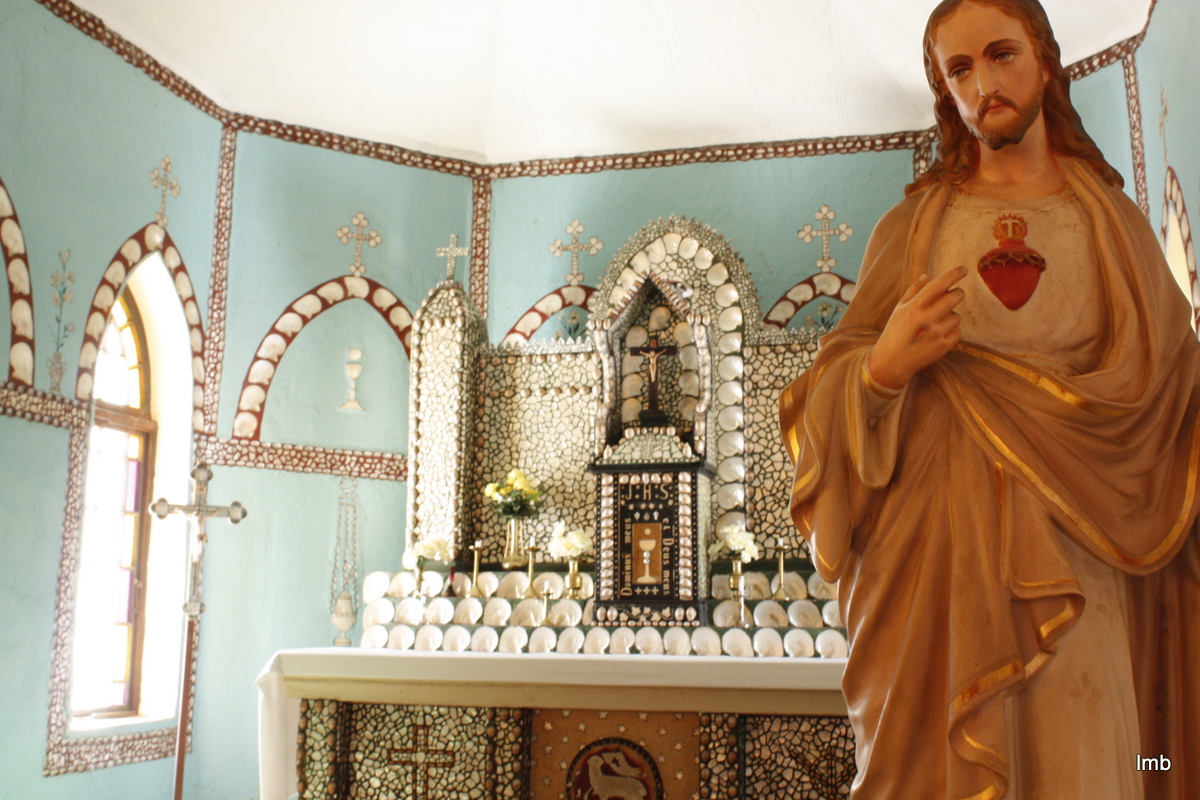
While under house arrest in 1915 during World War I, the German priests and brothers and the local people began building Sacred Heart Church. Taking two years to build, Sacred Heart was molded after a photo of a German country parish - but couldn’t be further from one. Much of the detail of the church, including the alter, is made from mother of pearl, cowries, volutes and olive shells – paying tribute to the surrounding beauty of the land and heritage of the local people.

Other popular Dampier Peninsula activities include mud crabbing, aboriginal tours and helicopter rides.

Dampier Peninsula

Cape Leveque

low tide, Cape Leveque

Cape Leveque

Sacred Heart Church, Beagle Bay

Sacred Heart Church, Beagle Bay

Sacred Heart Church, Beagle Bay

Sacred Heart Church, Beagle Bay

Sunday, September 4, 2011

Windjana Gorge & Tunnel Creek


Only days after passing through Port Hedland on the way home from our recent trip, the oldest evidence of life on Earth was discovered a short distance from the town of 15,000 people. As scientists from around the globe were chipping away to uncover 3.4 billion year old fossils, I was checking my phone for the first evidence of mobile reception in over five hours.

Signs of life from Earth’s younger years are hardly unusual in this part of country. In the Kimberly an 80km area called Dinosaur Trackway is the home to thousands of fossilized footprints left by at least a dozen species of dinosaurs which lived 115 to 120 million years ago - representing the largest number of footprints, the greatest diversity of dinosaur types and the best footprint preservation ever found. When you live in a state the size of Western Europe and with only 2 million inhabitants, things tend to pretty much stay the same. This can sometimes be a bad thing. But when it comes to revealing Mother Earth’s secrets, it’s a good thing.

While we didn’t go chasing dinosaur footprints in the Kimberly, we did get in touch with primitive life in Windjana Gorge. Windjana Gorge sits along Australia’s famous Gibb River Road – an unpaved stretch of road through the Kimberly that is only accessible during the dry season.

Following four days in Broome we spent two nights at Windjana Gorge National Park, about 4.5 hours southeast of Broome and 1.5 hours southeast of Derby where the Gibb River Road begins.

Windjana Gorge was once a 375 million year old Devonian Reef from when this part of the world was under water. The 100 meter high walls of the 3.5km long gorge, which shoot up abruptly from the land, are an impressive site. The Lennard River carves its way through the reef which today is known as the Napier Range.

There’s something quite peaceful and romantic about swimming in an ancient gorge, and I’m sure the freshwater crocodiles that call it home would agree. When hiking the 7km return trail through the gorge you will see dozens of crocodiles basking in the sun along the banks. “Freshies” are the smaller, somewhat harmless relative of the saltwater crocodile but visitors are still advised not to swim in the gorge. Shane, along with another male group of tourists, succumbed to the heat and swam with the crocodiles but I cooled off with a shower back at the camp site. Freshwater showers and flushing toilettes are available at Windjana Gorge but we had to bring a generator to power our camping fridge.

An hour further down the Gibb River Road is Tunnel Creek, Western Australia’s oldest cave system. Visitors can walk through the 750 meter cave if willing to wade through water which at some points comes up to your knees. We came rather unprepared. Shane left his running shoes back at the camp site and had to navigate through the cave in flip flops and our headlamp had a flat battery which left us with only a small handheld torch (flashlight that is). When you’re Ill-equipped, wading through water in a dark cave filled with bats and snakes is a bit daunting so we only made it half way through the 750 meters.

Windjana Gorge was definitely worth driving 140km on an unpaved road, but after two days without the option of picking up an ice cream or even bottled water from the store, we were ready to move along to our next destination – Cape Leveque on the Dampier Peninsula.

Boab Prison Tree, Derby

Gibb River Road

Windjana Gorge

camping, Windjana Gorge National Park

Windjana Gorge

Windjana Gorge

swimming, Windjana Gorge

fossil, Windjana Gorge
hiking Windjana Gorge

sunset, Gibb River Road

Freshwater Crocodile, Windjana Gorge

Tunnel Creek

Tunnel Creek

Monday, August 22, 2011

Broome


Camel, Cable Beach

Broome, on the north coast of WA, is one of the state’s most popular and renowned tourist destinations. We recently spent four nights in Broome as part of a 12 day West Kimberly trip. If you’ve seen the movie Australia or watched Oprah’s Australian adventure, then you’ve seen images of the Kimberly region.

This town of less than 15,000 permanent residents is a 2.5 hour flight from Perth or a 2,200 km (1370 mile) drive. We took a fishing boat with us so endured the 22 hour drive from Perth to Broome along the Great Northern Highway which takes you through WA’s Wheat belt, then into the Midwest known for its springtime wildflowers, and finally the Pilbara – the heart of the state’s mining industry. With very little to see beyond dotted grain silos and distant mine sites, you appreciate the isolation and beauty of the landscape but begin to wonder why the hell you didn’t opt for the much quicker (and possibly cheaper) plane flight.

A great many hours on the Great Northern Highway elicits great conversations such as why does Australia have so many greats: the Great Australian Bight, the Great Barrier Reef, the Great Ocean Road, the Great Sandy Desert. Food and accommodation on the drive consists mostly of Roadhouse chips and short sleeps in the back of your 4WD.  So after some time it’s only natural to want to strangle your travel companion – especially when they run out of fuel on the exit ramp by your house after travelling 6,500 kms in 12 days and nearly 48 hours with no shower. Clearly all that driving led to a miscalculation of fuel consumption.

While Perth in the south gets 85% of its rain in the winter (June-August), Broome in the north has a tropical climate with a rainy season during the summer. This makes it a popular tourist destination from May to September when it’s dry and hot in the north but cool and rainy in the southern half of the country. This is also why it’s recommended to visit the Great Barrier Reef during Australia’s winter – if you go during summer you’ll be disappointed with rain and sometimes lots of it.

Broome is most famous for three things: the spectacular Cable Beach, its world famous South Sea Pearls and colorful pearling history, and for camel rides on the beach.

Cable Beach is a 22km stretch of white sand and turquoise waters and with a 9 meter tide that still leaves plenty of room to stretch your legs at its height, the beach feels nearly as wide as it is long. It’s also home to Broome’s popular camel rides and is one of Australia’s most famous nudist beaches. It’s a driving beach so even during the busy tourist season you can always find a private spot somewhere along its 22km stretch to park your car and get rid of those tan lines.

Camels were first brought to Australia in the mid-1800’s as a means of traveling across the arid continent and today over 1 million feral camels reside mostly in central Australia, in the Northern Territory. Bully the camel from Ships of the Desert camel tours took Shane and I on a 40 minute stroll along Cable Beach. We learned that all the camels are brought in from the wild and tamed within six months and were surprised to hear that they drink 22 liters of water a day, although can survive on significantly less.

When Oprah surprised her lucky guests with Pearls they were South Sea Pearls from Broome. We took a two hour pearl farm tour at Willie Creek Pearl Farm where we learned about how pearls are cultured and valued. To learn a bit about the dangerous and fascinating pearling history which began 150 years ago, you can also take the Pearl Luggers tour.

We could have easily spent a couple more days in Broome. We missed out on the 130 million year old dinosaur fossil and although this time we stayed at the Palm Grove Caravan Park I could easily be persuaded to stay at one of Broome’s luxury resorts. Next time we’ll fly.

Cable Beach

Cable Beach

Camels, Cable Beach

Camels, Cable Beach

Camels, Cable Beach

Red Dirt, Broome

Mother of Pearl, Oyster Shell

Oyster (with small brown crab living in top left corner of shell)

Willie Creek Pearl Farm

Cable Beach

Wednesday, April 6, 2011

Good Read: Batavia


There are some things, quite confidently, Americans know about Australia. It has a city named Sydney, its native wildlife includes strange animals like Kangaroos and Koalas, and it’s down under – somewhere.

There is one other well-known fact about Australia – which many of us are taught during our school days– and that is the history of the first British settlers who exported convicts to Australia. My husband’s paternal grandfather was brought to this country from England as a wee baby. His mother was an unwed mom so her family put her and her newborn son on a ship to Australia with the rest of the convicts and misfits. In Sydney, she met her husband whose family name determined the fate of Shane’s family name, and more recently mine. But this is a story for another time.

The book Batavia is not about the British settlers. What many people don’t know is that the first Europeans to set foot on Australia were not British but the Dutch, who discovered and mapped what is today the coast of Western Australia, two hundred years before the British discovered Australia’s East Coast.

It was the lucrative spice trade that brought Dutch sailors to this part of the world. Their twelve month journey which originated in Amsterdam would take them all the way around Africa, past India and conclude in what is now present day Jakarta, Indonesia.

Eventually, a more adventurous captain discovered that if he headed directly east from the southern tip of Africa, taking advantage of the “roaring forties” all the way to what is essentially Perth and up the coast of Australia then three months was shaved off the journey. Hence, the Zuidland (southland) was discovered. With a dangerous coastline of islands and coral reefs, an apparently barren and waterless mainland, and no obvious civilization to dominate, the Zuidland was ignored.

But, in 1629, the Dutch East India Company (the first company with a system of shares and investors) set sail on its’ maiden voyage their most glorious ship, the Batavia, filled with over 300 men, women and children and some of the company’s most precious jewels and coins. On the final leg of the journey the Batavia met its fate on the Abrolhos islands, off the coast of what is today the town of Geraldton, 450 kms or five hours north of Perth.

This disaster was only the beginning of what the book’s author, Peter Fitzsimons, describes as an “adults-only version of Lord of the Flies meets Nightmare on Elm Street.” What makes this amazing and true story even more fascinating is that it was not until the 1960’s that the wreck was discovered and human bones and artifacts were found on the islands. Today the Abrolhos remain a quiet group of 122 islands and atolls, occupied mostly by Cray fisherman with very little accommodation and tourism. Read a bit about the islands today and watch a short video here.

I was bemused (and amused) that Fitzsimons opens his book with a quote from fellow Missourian Mark Twain, written in the year 1897. Twain’s quote reads as follows:

“Australian history is almost always picturesque; indeed, it is also so curious and strange, that it is itself the chiefest novelty the country has to offer and so it pushes the other novelties into second and third place. It does not read like history, but like the most beautiful lies; and all of a fresh new sort, no mouldy old stale ones. It is full of surprises and adventures, the incongruities, and contradictions, and incredibilities; but they are all true, they all happened”

Whether or not Twain knew anything of the Batavia, his sentiments echo the heart of this story. I highly recommend this book no matter where you live. As it was only recently launched in Australia, it has yet to be published overseas but the book’s publisher assures me it will be published in the US, UK, and Singapore to name a few. If you are doing the e book thing, then it can be purchased through Amazon. Otherwise, coming soon to a Borders near you.  Errr, maybe not Borders.

Sunday, January 16, 2011

Fremantle


The port city of Fremantle is mysterious, unexpected, historical, eclectic, and dark yet delightful. It’s a place where creative types, backpacking travelers, the outlandish, and locals converge. It’s also the home of my favorite old church with sunshine colored doors, my favorite Italian restaurant, my favorite Asian food court, my favorite gelato and finally (deep breath) my favorite organic, rice bran oil, no trans fat, low saturated fat, GMO free, cinnamon sugar doughnuts - surprisingly mouth watering and thankfully only available on Friday, Saturday, and Sunday when the Fremantle Markets are open.

Fremantle IS my favorite corner of Perth. Located at the mouth of the Swan River, 19 kilometers west of the city, Fremantle has a vibrant urban appeal that in many ways Perth lacks.

Fremantle was founded in 1825 as a part of the Swan River Colony and the facades of many of the buildings still display their 19th century charm. Equally old churches appear to flag the ends of Fremantle’s main streets but churches aren’t the only reminder of the days of the Swan River Colony.

Sitting high on a hill alongside the Indian Ocean is the Round house – an eight cell prison and the oldest standing building in WA and first permanent building of the Swan River Colony. At the other end of town sits the much larger Fremantle Prison built in the 1850’s. Today it operates as a popular tourist attraction. Fremantle is a glorious example of Australia’s British convict history which adds to the intrigue and mysticism surrounding the city.

Although the Fremantle of the 1800’s still lingers like a tenacious ghost, the city streets of today are alive with trendy cafes, restaurants, and shops. The smell of coffee fills the morning streets while the scent of garlic and wood fire ovens will guide you to one of the areas many Italian restaurants during the days and nights.

But there’s also a seedy side to Fremantle. In between the charming shops and colorful cafes are tattoo parlors, questionable adult shops, fortune tellers, new age stores filled with promises of a better future, and an abundance of souvenir shops. Along the wharf sits large abandoned warehouses with no signs of rehabilitation. In Fremantle, anything goes and it’s this mix of new and old, sordid and sophisticated that gives Fremantle its personality.

The town itself is only half the equation. Every day ships from all over the world dock in Fremantle’s Harbor. We are fortunate to live just outside “Freo’s” doorstep and every time Shane and I pass the docks on our way to the beach one of us comments on the enormity of a standing ship as if it were the first time we had seen such a thing.

It’s not only cargo ships that grace Fremantle’s shores but yachts and fishing boats of all sizes can be viewed from Fisherman’s Wharf over a meal of fish and chips from one of the many seafood restaurants. Next door sits the Maritime Museum filled with stories of sunken ships and the history of WA’s first explorers.

A day in Fremantle would be at the top of my list for anyone visiting Perth. Friday through Sunday the Fremantle Markets are open which sell everything from produce to patchouli and my favorite organic, rice bran oil, no trans fat, low saturated fat, GMO free, cinnamon sugar doughnuts.

remains of the past

Maritime Museum

Scots Presbyterian

Fremantle Markets

Town Hall
Cafes on South Terrace

old warehouse

Wharf

High Street with the Round House prison at the end

an old facade disguising a parking lot

Round House prison

High Street from the Round House

Fisherman's Wharf

Wednesday, November 24, 2010

Shark Bay

Over the weekend Shane, Bronson and I spent three nights in Shark Bay. Shark Bay is an 8 hour drive north of Perth – a rather ambitious trip for three nights but that’s where we wanted to go so that’s where we went.

Shark Bay is not a bay per say but a World Heritage area consisting of two peninsulas. The southern peninsula is accessible only by an unpaved road. This road is appropriately named Useless Loop. Only a salt and gypsum mine resides on the peninsula producing the purest grade sea salt in the world. If you can handle the two plus hour drive on gravel road then camping and fishing are available by permit at Steep Point.  Shane seems to think we'll be making a trip there after the holidays.

We stayed in Denham, the only town on Peron peninsula to the north – population 1,500 and the western most town in Australia. A twenty minute drive from Denham on the opposite side of the peninsula is Monkey Mia – a small resort and famous spot for feeding and interacting with wild dolphins. In the 1960’s local fisherman began feeding the dolphins. Ever since then, the dolphins have come to the same beach to be fed by the people. Disclaimer: uncomplicated and unrefined does not support feeding wildlife but it seems to work at Monkey Mia and is a pretty amazing example of the relationship between wildlife and humans.

I’ve always associated Shark Bay with Monkey Mia as it has a bit of a reputation for attracting overseas tourists wanting to interact with the dolphins. I was delighted to discover that it’s an area with a special history and unique wildlife.

At the end of Useless Loop lies Dirk Hartog Island – an 80km island and the largest island in WA. It houses an eco-tourism resort accessible by plane. Dirk Hartog (great name) was a Dutch captain who landed on the island in 1616 when his ship was blown off course. He decided it was inhabitable so nailed a pewter plate to a tree proclaiming he was there and went on his merry way. In 1697 another Dutch captain, William de Vlamingh, landed on the island and replaced Hartog’s plate with his own. William spent some time exploring the west coast of Australia and the existence of any Dutch settlers is a mystery to this day. Some say there are aboriginals with Dutch ancestry running through their veins. It wasn’t until 1770 that Captain James Cook landed on the east coast, outside of Sydney, and the first British settlement began in 1778 - over one hundred years from when the Dutch first landed on the west coast.

Shark Bay’s history dates back much further than the 17th century. Hamelin Pool which sits at the base of Peron Peninsula is one of only three places in the world where living marine stromatolites exist – the other two are in the Bahamas. Stomatolites are one of the earliest forms of life on Earth – their existence dating back over 3 billion years. The high salt content of Hamelin Pools allows them to continue to thrive. And I can’t help but think that the lack of human contact in this area also plays a role in their survival.


The high salt content of the ocean can also be thanked for beautiful Shell Beach where Shane stands in the photo up top. This beach is made of trillions of tiny shells named the Hamelin Cockle which wash up and form piles up to 10m thick on an amazing beach that is several kilometers long and at points 1km wide.


In case I haven’t convinced you that Shark Bay is a magical place, it’s also home to Blue Lagoon Pearl Farm.

But possibly my favorite part of Shark Bay is the amazing wildlife. We had the opportunity to watch a father Emu (the dad rears the young) and his 14 chicks navigate their way through the bush and cross the two lane road.


All I wanted to see on this trip was a Dugong and after 7 hours at sea we finally saw one as we were heading in for the day. Dugongs (which you may know as Manatees) are the world’s only marine mammal herbivore and an amazing 10% of the world’s population lives in Shark Bay.  I was too mesmerized and he was too sneaky for me to capture anything on camera aside from the tip of his tail.

I’m fortunate to have a husband with a particularly keen ability to spot wildlife that I would otherwise miss. “Look, there’s an eagle, a snake, an emu, a roo (kangaroo), a hawk, a goat, a fox, a racehorse lizard, a sea turtle, a ray, a dugong, a school of fish” And we saw all of these in Shark Bay. He’s like my own personal Crocodile Dundee. If only I looked like Linda Kozlowski in that one-piece thong swimsuit

fishing

Eagle Bluff